Skip to content
celtek-peptides.com

celtek-peptides.com

  • Shop
    • Custom Peptide Synthesis
    • Retatrutide
    • My account
  • About Celtek
  • Research
  • Support
    • Quality Standards
    • Testing & COA
    • Research Use Only
    • Shipping & Delivery

Yao Lin

Peptide Acetate Salt vs TFA Salt: What Changes in the Material?
October 24, 2026 by Yao Lin
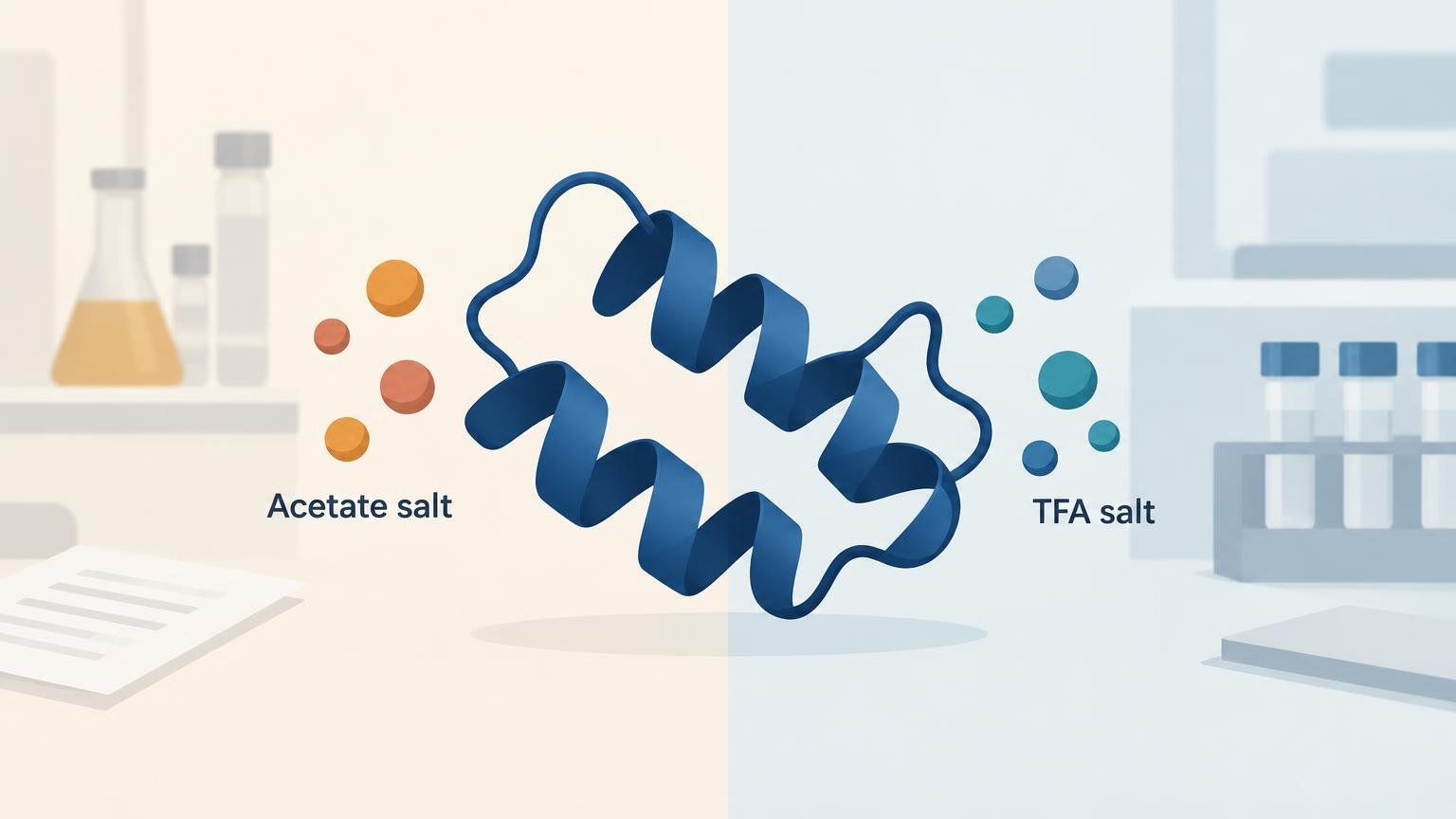
Editorial laboratory illustration showing a blue coiled peptide ribbon between orange particles labeled “Acetate salt” and teal-blue particles labeled “TFA salt,” with blurred glassware and vials in the background.

Acetate and TFA salt designations usually refer to different counterions associated with the same covalent peptide. The difference can affect total material composition, mass calculations, physicochemical behavior, and the analytical evidence needed to characterize a lot.


Categories Peptide Science

Celtek Peptides vs Peptidology: Which Research Peptide Supplier Scores Better?

October 22, 2026 by Yao Lin
Flat editorial illustration of a laboratory researcher holding a clipboard beside folders, analytical chart printouts, a large magnifying glass, glassware, and test tubes.

Celtek Peptides narrowly leads Peptidology in the supplied research-supplier scorecard, while Peptidology earns the stronger regulatory and stability score. This comparison explains the scores, documentation claims, shipping policies, and analytical limits relevant to laboratory procurement.

Categories Peptides

Fmoc vs Boc Peptide Synthesis: Why the Protecting-Group Strategy Matters

October 20, 2026 by Yao Lin
Wide flat-style laboratory illustration of two scientists in white coats working from opposite sides toward a central vertical molecular model, with blue and orange reaction arrows, geometric chemical shapes, bottles, and a pipette.

Fmoc/tBu and Boc/Bzl are complete protection-and-cleavage systems, not merely two interchangeable N-terminal groups. This guide compares their chemistry, workflows, limitations, and target-dependent use cases.

Categories Peptide Science

Long Peptide Synthesis: Why Sequence Length Changes Yield and Purity

October 17, 2026 by Yao Lin
Flat editorial illustration of a laboratory scientist observing a colorful linked peptide chain that breaks into scattered pieces as it passes through a perforated filter panel, then continues on the other side.

Long peptide synthesis is governed by more than residue count. Cumulative reaction losses, sequence-dependent aggregation, related impurities, and purification recovery determine whether a proposed route is practical.

Categories Peptide Science

Analytical Variability in Peptide Testing: Why Two Labs May Not Report the Same Number

October 15, 2026 by Yao Lin
Flat editorial illustration of two laboratory scientists testing sample vials beside separate instruments and blue and orange chromatogram displays, with one central sample tube linked to both results.

Two laboratories can produce different peptide results without either result being obviously wrong. A defensible comparison starts by confirming the measurand, sample equivalence, method, calibration, data processing, and uncertainty.

Categories Peptide Testing & Analysis

How to Store Lyophilized Peptides for Laboratory Research

October 13, 2026 by Yao Lin
Illustration of a gloved hand placing an amber vial in an open carton beside a desiccant packet, checklist, and laboratory cold-storage cabinet marked with thermometer and snowflake symbols.

A research-oriented guide to storing lyophilized peptides based on product-specific stability data, package integrity, environmental controls, and documented handling.

Categories Peptide Stability & Storage

Peptide Lot Traceability: Connecting a Vial, Lot Number, and Test Report

October 10, 2026 by Yao Lin
Flat editorial illustration of a laboratory professional holding a small product box and a report beside an amber vial, with a curved line and matching diamond markers visually linking the vial, box, and document.

A practical framework for connecting a peptide vial or package to its lot-specific certificate of analysis and supporting analytical records without overstating what that documentation proves.

Categories Peptide Testing & Analysis

Peptide Oxidation Explained: Common Residues and Degradation Pathways

October 8, 2026 by Yao Lin
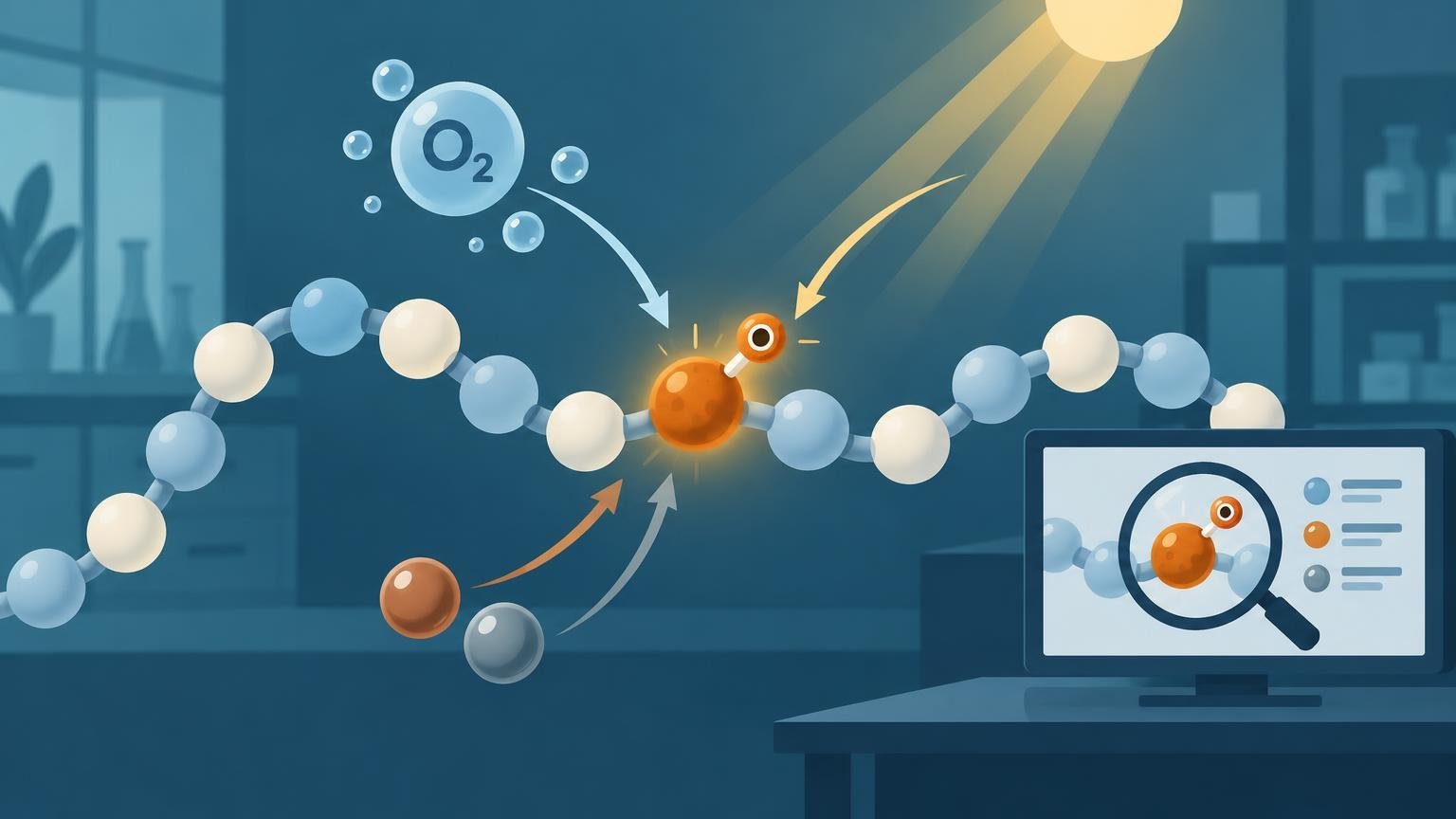
Illustration of a peptide-like chain with a highlighted orange oxidized site, oxygen bubbles labeled “O₂,” arrows, sunlight, metal-like spheres, and a computer screen showing molecular analysis in a laboratory.

A research-oriented guide to oxidation-prone peptide residues, oxygen-, light-, and metal-driven pathways, and the analytical evidence needed to localize oxidative modifications.

Categories Peptide Stability & Storage

How to Read a Peptide HPLC Chromatogram

October 3, 2026 by Yao Lin
Editorial laboratory illustration of a scientist in a white coat viewing a monitor with a chromatogram-like graph showing three peaks, including one tall teal peak highlighted by an orange circular callout.

A practical guide to reading peptide HPLC chromatograms without confusing retention time, peak area, chromatographic purity, molecular identity, or absolute peptide content.

Categories Peptide Testing & Analysis

LC-MS Peptide Identity Confirmation: Mass, Charge States, and Orthogonal Evidence

October 1, 2026 by Yao Lin
Flat editorial illustration of a scientist in a laboratory viewing a large panel with simplified chromatogram peaks, mass-spectrum-like bars, layered data shapes, dot patterns, and a central test tube icon.

Learn how LC retention behavior, intact mass, charge-state patterns, isotope evidence, and MS/MS can support synthetic peptide identity—and where ambiguity remains.

Categories Peptide Testing & Analysis

Celtek Peptides vs Modern Research Peptides: Quality Testing or Lowest Price?

September 29, 2026 by Yao Lin
Flat editorial illustration of a lab professional reviewing a chart beside a sample vial, folders, a price tag icon, and a balance scale in a muted teal and beige laboratory setting.

A transparent, scorecard-based comparison of Celtek Peptides and Modern Research Peptides for laboratory procurement, including testing documentation, price, catalog, shipping, and analytical limitations.

Categories Peptides

Thymosin Beta 4 vs TB-500: Names, Sequences, and Research Distinctions

September 26, 2026 by Yao Lin
Flat editorial illustration comparing a long chain of colored molecular beads on a teal background with a shorter bead chain under a magnifying glass on a coral background; a small panel below shows two simplified analytical charts.

Full-length thymosin beta-4 and the seven-residue fragment commonly identified as TB-500 are related but chemically distinct. This guide compares their sequences, naming, research records, and analytical verification requirements.

Categories Peptide Science

How pH Changes Peptide Stability, Charge, and Solubility

September 24, 2026 by Yao Lin
Flat editorial illustration of a scientist in a lab coat holding a small vial beside three large round flasks containing differently arranged colorful molecular models.

Peptide formulation pH affects ionization, solubility, chemical degradation, and aggregation at the same time. This guide explains why the best pH must be determined experimentally rather than inferred from pI alone.

Categories Peptide Stability & Storage

Peptide Sterility Testing vs Purity Testing

September 22, 2026 by Yao Lin
Flat editorial illustration of a lab scientist in a white coat examining an amber vial, with connected icons for a shield, molecular dots, a color chart, a tagged bottle, and a small sample vial.

Sterility, bacterial endotoxin, molecular identity, chromatographic purity, and peptide content are separate quality attributes. This guide explains what each test can establish, what it cannot establish, and how to review lot-specific peptide documentation.

Categories Peptide Testing & Analysis

Celtek Peptides vs Core Peptides: Broad Catalog or Stronger Overall Testing and Value?

September 17, 2026 by Yao Lin
Editorial laboratory still life with numerous clear, blank-labeled sample vials on a dark bench, one vial enlarged through a metal magnifying glass, and tweezers, a glass dish, and a translucent slide nearby.

A research-procurement comparison of Celtek Peptides and Core Peptides based on the supplied seller scorecard, published policies, and analytical-documentation examples.

Categories Peptides
Older posts
Page1 Page2 Next →

Celtek Peptides

For Research Use Only. Not for human or veterinary use.

1515 Elm Hill Pike
Nashville, TN 37210, USA
contact@celtek-peptides.com

Shop & Services

Peptide Synthesis
Shop Peptides
Custom Quotes

Research

Research & Articles
Retatrutide Research
Peptide Science
Testing & Analysis
Storage & Stability
Celtek Publications

Support

Testing & COAs
Quality Standards
Research Use Only
Shipping & Delivery
Returns & Replacements
Contact

Celtek Peptides supplies materials for laboratory research and development only. Products designated for research use are not intended for human or veterinary use, diagnostic use, or therapeutic use.

© 2026 Celtek Peptides. All rights reserved | Privacy Policy | Terms & Conditions