
TLDR
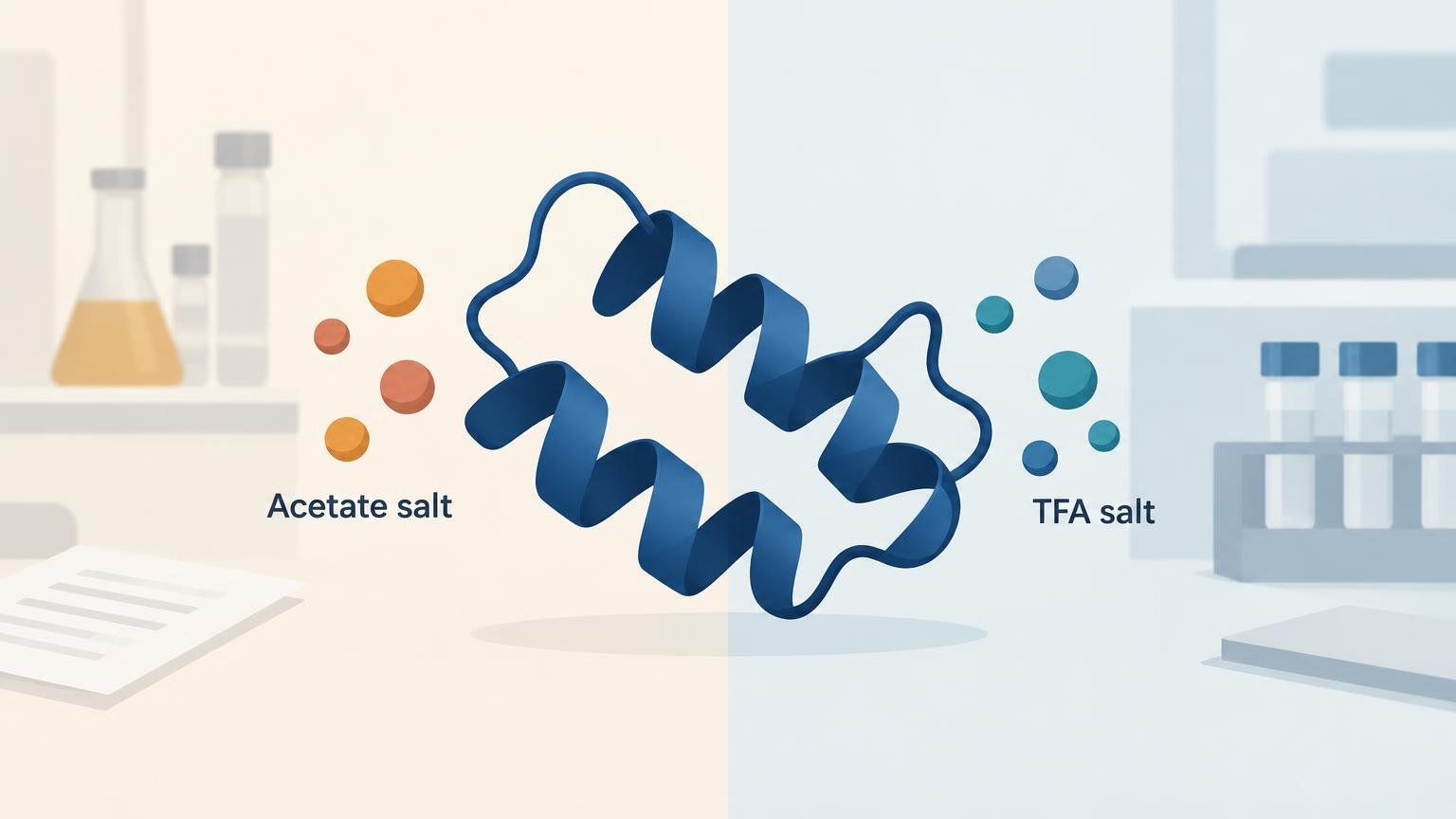
A peptide acetate salt and the corresponding TFA salt generally contain the same covalent peptide but different negatively charged counterions. Acetate has an approximate anion mass of 59.04 Da, while trifluoroacetate has an approximate anion mass of 113.02 Da. For each counterion equivalent, TFA therefore contributes about 53.98 Da more than acetate to the nominal salt mass. The practical difference is not limited to molecular-weight arithmetic: counterion identity and amount can influence material composition, physicochemical behavior, assay interpretation, and mass-based experimental calculations. A salt designation alone does not establish exact stoichiometry, peptide content, residual TFA, water, or other constituents. Those questions require appropriate lot-specific measurements.
The peptide sequence usually does not change
The first distinction is between the covalent peptide and the ions associated with it. Changing a peptide from a TFA salt to an acetate salt ordinarily changes the counterion, not the amino-acid sequence or an intended covalent modification. The positively charged sites on the peptide are balanced by negatively charged trifluoroacetate or acetate ions.
TFA commonly appears in peptide workflows because trifluoroacetic acid is used during cleavage and deprotection in solid-phase peptide synthesis and as an ion-pairing reagent in reversed-phase chromatography. A peptide purified under TFA-containing conditions may consequently be isolated with TFA-associated counterions.
This does not mean that every peptide contains one counterion. The relevant stoichiometry depends on charge context: the number and protonation state of basic groups, the termini, sequence-dependent behavior, terminal modifications, and the conditions under which the material was isolated. Peptide length by itself is not enough to calculate the number of associated anions.
What changes between acetate and TFA salts?
| Attribute | Acetate salt | TFA salt | Interpretive point |
|---|---|---|---|
| Counterion | Acetate, CH3COO− | Trifluoroacetate, CF3COO− | The covalent peptide can remain unchanged while the associated anion differs. |
| Approximate anion mass | 59.04 Da | 113.02 Da | TFA adds about 53.98 Da more per anion equivalent. |
| Common process context | May result from acetate exchange or acetate-containing processing | Can result from TFA cleavage, purification, or isolation conditions | Process history can influence the counterion profile. |
| Exact composition | Not established by the words “acetate salt” | Not established by the words “TFA salt” | Stoichiometry and residual ions require measurement. |
| Chromatographic purity | Does not quantify acetate by itself | Does not quantify TFA by itself | Peptide HPLC purity and counterion content are different measurands. |
The numerical mass difference becomes important when comparing material on a weighed basis. Consider a simplified peptide carrying three protonated sites and associated with three monovalent anions. Replacing three acetates with three TFA anions would increase the nominal counterion contribution by approximately 161.94 Da. That calculation is useful as a theoretical model, but it is not proof that a particular lyophilized lot has exactly three counterions per peptide molecule.
Actual material may contain residual counterions after an exchange attempt, additional or adsorbed acid, water, residual solvents, and other constituents. The weighed powder mass therefore should not automatically be treated as an equal mass of peptide free base across different salt forms.
Charge context determines the theoretical stoichiometry
A useful starting point is to identify the peptide's potentially protonatable groups. These can include the N-terminus when it is not blocked and basic side chains such as those in lysine and arginine. Histidine can also contribute depending on the conditions. Acidic groups, terminal amidation or acetylation, and solution pH complicate the net-charge picture.
A charge-based calculation can estimate how many monovalent counterions might be required for electroneutrality under an assumed protonation state. It remains a model, not a substitute for composition testing. Protonation is condition-dependent, and isolated solids do not necessarily behave as an ideal, single-stoichiometry salt. This is why two samples bearing the same salt designation can differ in counterion content on an as-is basis.
Purity, identity, and counterion content answer different questions
A high HPLC or UPLC purity result describes the relative chromatographic signal assigned to the main peptide peak under the stated method. It does not, by itself, quantify acetate or TFA, establish peptide content by mass, or measure water and residual solvents. Likewise, evidence that the observed peptide mass agrees with the expected covalent molecule does not automatically provide the counterion amount.
This separation of measurands is reflected in the European Medicines Agency guideline on synthetic peptides, which treats purity, assay or content, counterion identity and content, residual TFA, water, and residual solvents as distinct characterization or specification attributes. The FDA likewise states in its drug-substance guidance that counterion stoichiometry should be addressed during chemical-structure confirmation.
Researchers evaluating a lot should therefore ask what each reported result actually measures. The broader principle is explained in this guide to peptide purity measurements: one reassuring percentage cannot replace several chemically distinct tests.
What useful documentation may include
- Peptide identity evidence, such as an appropriate mass-spectrometric result.
- Chromatographic purity under a defined HPLC or UPLC method.
- Counterion identity and, when composition matters, quantitative counterion content.
- Peptide assay or content rather than an assumption that total powder mass is peptide mass.
- Water and residual-solvent measurements when relevant to the intended calculation.
- Clear lot identification connecting the material to its analytical report.
Dedicated counterion methods are preferable to inference. USP maintains a chapter specifically addressing acetic acid in peptides, and a published capillary-electrophoresis method measured both acetic acid and TFA in synthetic peptide samples. Other reported approaches include ion chromatography, quantitative NMR, and suitably validated liquid-chromatography methods. Method suitability still depends on the analyte, matrix, range, and required accuracy.
Does the counterion affect peptide behavior?
It can, but the effect should not be generalized beyond the system studied. Counterion type may alter physicochemical properties and can influence measured biological behavior in particular assays. Regulatory guidance consequently treats counterion identity and amount as meaningful characterization variables rather than decorative naming details.
Published comparisons have reported counterion-dependent differences for selected antimicrobial peptides, but those findings are sequence- and assay-dependent. They do not establish that acetate is universally superior to TFA, or that changing the salt will improve every peptide preparation. From a biochemical perspective, the defensible question is narrower: does counterion identity materially affect the specific peptide, concentration, matrix, endpoint, and assay being used?
Salt exchange is a process, not a relabeling step
Converting a TFA salt to an acetate salt requires counterion exchange. Published approaches include reversed-phase HPLC with an acetate-containing mobile phase, acetate-form anion-exchange resin, dissolution and repeated lyophilization strategies, and deprotonation followed by reprotonation with the desired acid.
Exchange efficiency depends on both the method and the peptide. In one study of cationic peptides, reversed-phase HPLC and ion-exchange approaches produced outcomes ranging from partial to nearly complete exchange, while a deprotonation and reprotonation cycle removed TFA under that study's conditions. The authors also noted that strongly acidic conditions can raise degradation concerns for susceptible sequences.
An earlier HPLC-based report found no detected TFA or degradation for the specific growth-hormone-releasing-factor example it examined. That result supports the reported method for that example; it is not a universal guarantee for unrelated sequences.
After exchange, the analytical question is not simply whether acetate was introduced. It is whether residual TFA remains, how much acetate is present, whether the peptide's chromatographic profile and identity remain acceptable, and whether content or water changed during processing. If those attributes matter to the experiment, they should be measured after the exchange rather than assumed from the process description.
How to compare two lots responsibly
A useful comparison begins by confirming that both lots contain the same intended covalent peptide, including terminal modifications. Then compare counterion identity, quantitative counterion results where available, peptide content, chromatographic purity, water, and other composition attributes relevant to the planned assay. Lot-specific documentation should be traceable to the received material; peptide testing and certificate documentation can help organize that review.
For mass-normalized experiments, decide whether the calculation is based on total material, peptide salt, anhydrous salt, or peptide free-base equivalent. These are not interchangeable quantities. If the documentation does not establish the required conversion, reporting the preparation on a nominal weighed-material basis may be more transparent than implying a peptide amount that was not measured.
Frequently asked questions
Is acetate salt the same peptide as TFA salt?
Usually, the intended covalent peptide is the same and the associated counterion differs. Confirm the sequence, terminal modifications, identity data, and lot documentation rather than relying solely on the product name.
Does 99% HPLC purity mean the powder is 99% peptide?
No. Chromatographic purity is a relative result produced by a particular separation and detection method. It does not automatically quantify counterions, water, residual solvents, or peptide content on an as-is mass basis.
Can the TFA content be calculated from peptide molecular weight?
A theoretical estimate can be made from an assumed charge state and counterion stoichiometry, but molecular weight alone does not establish the actual TFA content of a lyophilized lot. Direct measurement is needed when quantitative composition matters.
Is TFA-to-acetate exchange always complete?
No. Published results show that exchange efficiency varies with the peptide and method. Residual TFA should be measured when the degree of exchange is important to interpretation.
The practical conclusion
The central difference between peptide acetate and TFA salts is the counterion associated with the charged peptide, not ordinarily the peptide sequence itself. That difference changes nominal salt mass and may change physicochemical or assay behavior, but the label alone does not reveal exact material composition. The strongest comparison uses lot-specific measurements that separate peptide identity, chromatographic purity, peptide content, counterion identity and amount, water, and other relevant constituents. For research calculations, define which mass basis is being used before treating acetate and TFA materials as interchangeable.
References
- Towards a Consensus for the Analysis and Exchange of TFA as a Counterion in Synthetic Peptides and Its Influence on Membrane Permeation – PMC
- Guideline on the Development and Manufacture of Synthetic Peptides
- The Study of Antistaphylococcal Potential of Omiganan and Retro-Omiganan Under Flow Conditions – PMC
- Guidance for Industry #169 – Drug Substance
- 〈503〉 Acetic Acid in Peptides
- Capillary electrophoretic determination of acetic acid and trifluoroacetic acid in synthetic peptide samples.
- Counter-ion effect on antistaphylococcal activity and cytotoxicity of selected antimicrobial peptides – PMC
- Simple, rapid method for converting a peptide from one salt form to another.
- Elimination and exchange of trifluoroacetate counter-ion from cationic peptides: a critical evaluation of different approaches – PubMed