
How to Store Lyophilized Peptides for Laboratory Research
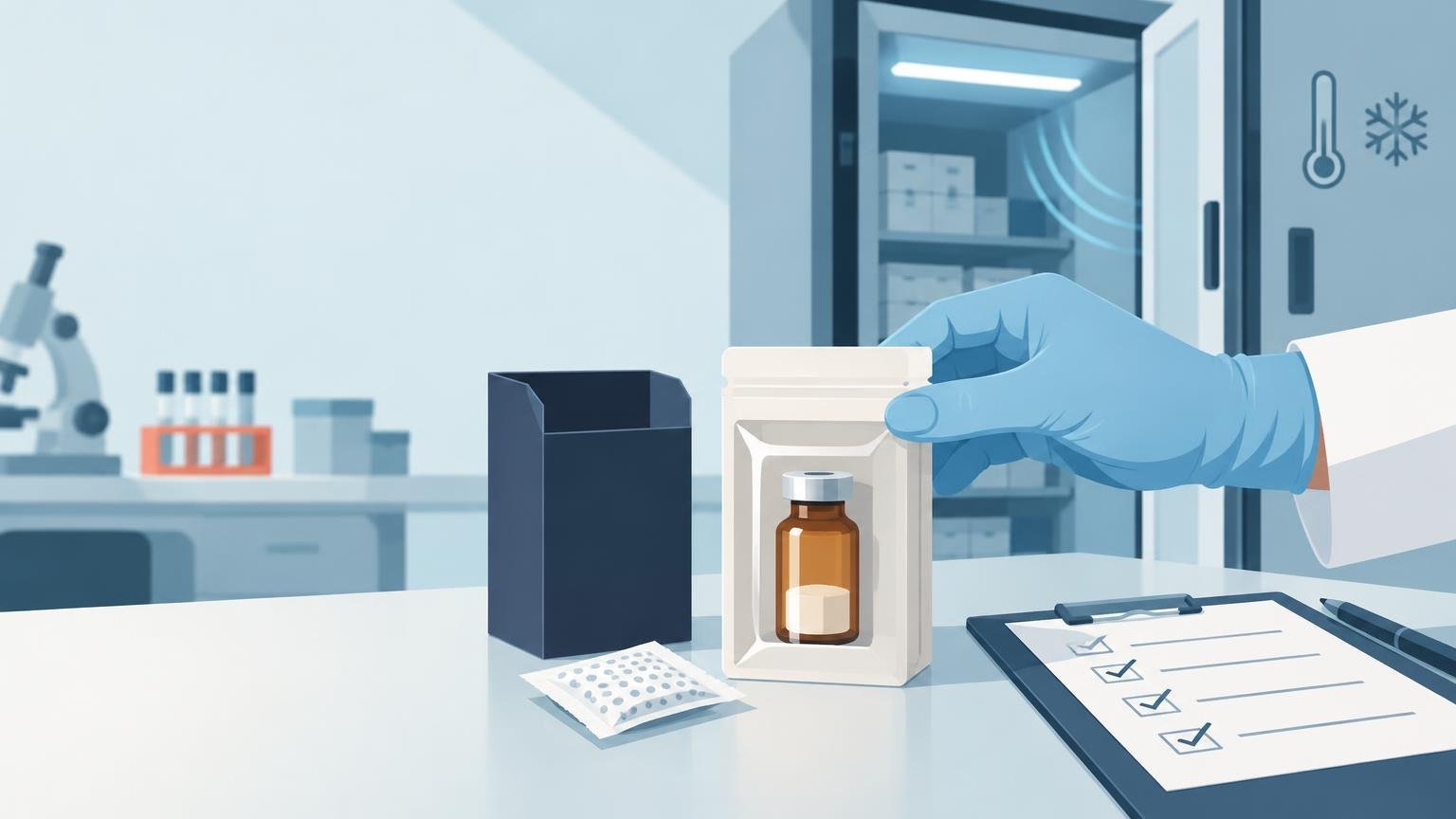
A research-oriented guide to storing lyophilized peptides based on product-specific stability data, package integrity, environmental controls, and documented handling.
A research-oriented guide to storing lyophilized peptides based on product-specific stability data, package integrity, environmental controls, and documented handling.

A research-oriented guide to oxidation-prone peptide residues, oxygen-, light-, and metal-driven pathways, and the analytical evidence needed to localize oxidative modifications.

Peptide formulation pH affects ionization, solubility, chemical degradation, and aggregation at the same time. This guide explains why the best pH must be determined experimentally rather than inferred from pI alone.

Peptide photostability depends on sequence, formulation, oxygen, light spectrum, exposure, and packaging. Learn what light-stress studies can—and cannot—establish.
TLDR A peptide can have the correct sequence when it is synthesized and still become a chemically different material later. Sometimes a bond breaks. Sometimes an amino acid side chain is oxidized. Sometimes an asparagine residue rearranges. And sometimes the peptide remains chemically unchanged but begins associating with other peptide molecules until aggregates or fibrils … Read more
TLDR A peptide stability study is really a study of change. Researchers begin with a characterized peptide and repeatedly ask the same question: Is it still the same material? That sounds simple until we define what “same” means. A peptide could retain 99% chromatographic purity while forming a small amount of aggregate. It could maintain … Read more
TLDR Retatrutide does not currently have an FDA-approved commercial shelf life. As of September 2026, Eli Lilly still describes retatrutide as an investigational injectable in Phase 3 development and says it is not available for public use. Lilly’s publicly available clinical-trial protocol requires retatrutide to be stored according to sponsor-labeled conditions in a monitored environment, … Read more
TLDR Ozempic is a liquid semaglutide injection, and its shelf life depends on the presentation and how it has been stored. For the standard multi-dose Ozempic pen, an unused pen kept refrigerated at 36°F to 46°F (2°C to 8°C) can be used until the expiration date printed on the label. Once the pen is first … Read more
TLDR Lyophilized peptides have a distinctive appearance. Instead of a liquid, the material commonly forms a light, porous solid or “cake” inside a vial. That solid did not form by simply allowing the water to evaporate. It was produced through a carefully controlled process involving freezing, vacuum, heat transfer, sublimation, and final drying. The process … Read more
TLDR A peptide can look extraordinarily potent in a dish and fail completely in a living organism. That does not necessarily mean the original experiment was wrong. It may simply have answered a different question. This distinction is at the heart of in vitro vs. in vivo peptide research. An in vitro receptor assay might … Read more