
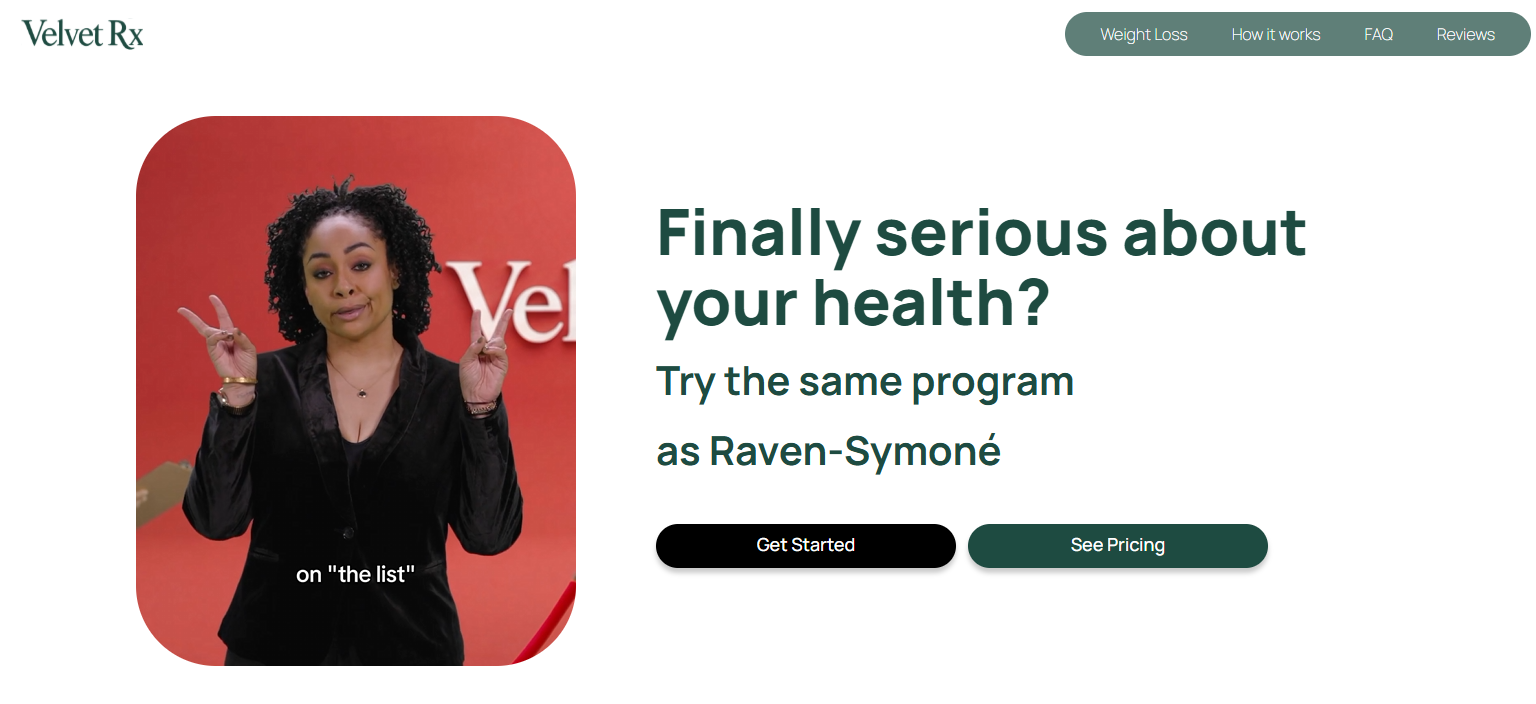
An online peptide business can display medical logos, transformation photographs and thousands of reviews without showing what those signals actually establish. VelvetRx offers a case study in why scientific claims need to be examined separately from persuasive website design.
An October 26 investigation by RippedMeOff documented AI-generated stock images presented as customer transformations, an institutional affiliation denied by Stanford, identical review totals across three storefronts and supposedly daily treatment-selection figures that remained unchanged.
The findings concern marketing and substantiation. They do not negate clinical research supporting approved GLP-1 medicines. They demonstrate why evidence about a drug cannot automatically validate the business selling access to it.
AI Images Presented as Treatment Results
VelvetRx’s captured homepage displayed a customer-results carousel with names, ages, weight-loss totals, treatment timelines and verification-style badges.

Two examples were matched to stock listings explicitly identified as AI-generated. “Jasmine,” described as 31, was credited with losing 54 pounds over an eight-month timeline. The corresponding artwork appears in this Magnific listing. “Lauren,” described as 37, was credited with losing 84 pounds over six months; her transformation matches another AI-generated listing.
That establishes a concrete problem with the photographic evidence. An AI-generated image cannot document what happened to a patient receiving treatment. Whether any accompanying written account reflects a genuine experience requires separate substantiation.
Even authentic before-and-after photographs have scientific limitations. Without treatment records, measurement methods, duration and information about other interventions, they cannot establish how much change a particular medication caused.
Reliable outcome claims should identify the studied product, population, comparison group, follow-up period and adverse-event findings. Selecting an impressive individual transformation cannot show how typical that outcome is, how many participants stopped treatment or whether the advertised preparation was the one actually studied.
The FTC’s Consumer Review Rule addresses testimonials that misrepresent a person’s existence or experience, including specified uses of AI-generated false testimonials. The relevant question is what the advertisement represents as real.
Prestige and Popularity Without Clear Sources
The investigation also documented Stanford’s logo among recognizable institutional and media brands on VelvetRx’s homepage. RippedMeOff reported that Stanford’s trademark representatives denied any affiliation in direct correspondence.
That denial concerns Stanford specifically. It does not establish the status of every other logo. It does undermine the assumption that a prominent institutional name necessarily represents a verified relationship.

The review totals raise another substantiation issue. VelvetRx, Rejuve Meds and VivaRX each displayed 14,532 reviews in captured intake funnels, without explaining a shared source or whose customer experiences were included.
Identical totals alone do not prove fabricated reviews. They leave readers unable to determine what the number measures.
The homepage’s treatment-selection figures were similarly problematic:
| Offering | Claimed selections “today” |
|---|---|
| Semaglutide | 15,786 |
| Tirzepatide | 10,979 |
| Oral GLP-1 | 7,653 |
Together, these represent 34,418 claimed treatment selections, not necessarily unique patients. RippedMeOff reported that all three figures remained unchanged across checks on different days and at different times.
Precise numbers can create confidence. Their precision does not establish their accuracy.
The Advertising Operation Behind VelvetRx
VelvetRx’s terms identify Rocket Health Inc. as the business behind the website. California corporate information reproduced by Bizprofile lists Dean Richard Rojas as CEO and director, and Michael Timothy Woolsey as CFO and secretary. The company was incorporated on July 28, 2025, according to the same public corporate-records listing.
Both men also established GASSED, a performance-marketing agency. Rojas has publicly described an operation capable of producing more than 800 direct-response video creatives monthly at full capacity.
The investigation connected GASSED to VelvetRx through advertising configurations and documented mobile ads featuring exaggerated injection imagery, an $89 “for life” price hook and a claim that tirzepatide “crushes” Ozempic. Raven-Symoné’s name and image supplied another prominent promotional cue.
These elements explain how attention becomes interest and confidence. Neither advertising expertise nor celebrity familiarity establishes product quality, clinical outcomes or the accuracy of a testimonial.
FDA Approval Belongs to the Product
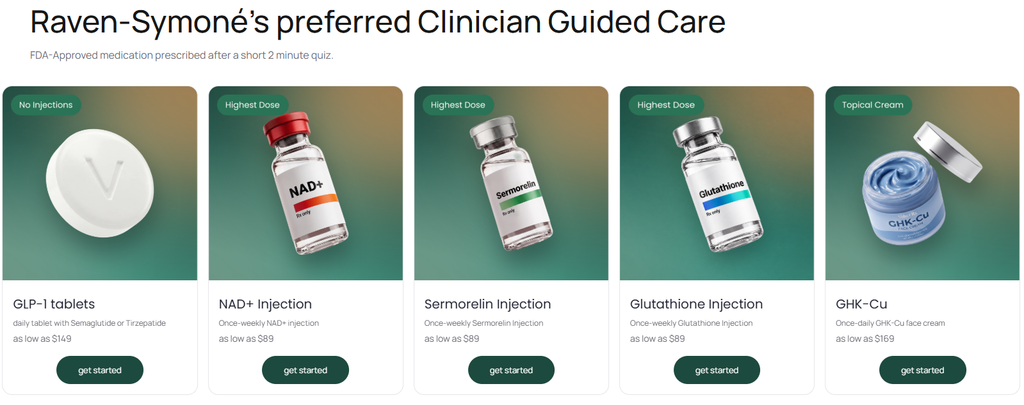
VelvetRx’s captured treatment section introduced its offerings with: “FDA-Approved medication prescribed after a short 2 minute quiz.”
The carousel included tablets described as containing semaglutide or tirzepatide, alongside NAD+, sermorelin and glutathione injections and GHK-Cu cream.
FDA approval is specific to a drug product, including its formulation and route of administration. An ingredient name does not transfer approval to every preparation containing it.
In its May 2026 notice, the FDA explicitly stated that no tirzepatide product was approved for oral, sublingual or buccal administration. Approved tirzepatide products are injectable.
Oral semaglutide requires a different explanation: approved oral products exist. However, a compounded tablet does not inherit their approval.
Formulation also matters scientifically. FDA-approved labeling describes oral semaglutide products containing the absorption enhancer SNAC. Naming semaglutide as an ingredient does not demonstrate that another tablet produces equivalent exposure or clinical outcomes.
The FDA states that compounded drugs are not FDA-approved and are not reviewed for safety, effectiveness and quality before marketing. Compounding can serve legitimate medical needs; its approval status still must be represented accurately.
The necessary disclosure is therefore product-specific: what preparation is supplied, who manufactures or compounds it, what its approval status is, and what evidence supports claims about that formulation.
Certification Has a Defined Scope
VelvetRx’s intake infrastructure connects to Rimo, which markets systems for branded telehealth businesses and assistance obtaining LegitScript certification.
Rimo’s platform page advertises pricing from $2,500 monthly, with consultation and processing fees separate. Its terms place responsibility for submitted content on operators and say Rimo does not pre-screen those materials.
RippedMeOff reported checking LegitScript’s public listings on October 25, 2026, and confirming certification for VelvetRx, Rejuve Meds and VivaRX. The finding concerns actual certification, not merely badges displayed by the businesses.
Yet the documented marketing problems appeared on certified storefronts.
In a separate September investigation, CBS News reported more than 80 businesses promoting unapproved retatrutide while touting LegitScript certification. LegitScript told CBS that its monitoring had flagged those businesses and described responses including suspensions and corrective action. That reporting adds context without establishing what happened in VelvetRx’s own certification review.
A certification cannot substitute for FDA product approval or independently establish that a particular customer photograph, review total or treatment claim is accurate. The businesses, platform and certifier should explain which claims were examined and how misleading material is addressed.
What Meaningful Evidence Looks Like
For peptide science, several different questions must remain separate. A molecular identity result addresses what material was detected. A purity measurement describes specified analytical findings. Clinical evidence evaluates outcomes under defined study conditions. Regulatory approval concerns a particular drug product.
As Celtek’s quality standards explain, routine HPLC and mass-spectrometry results do not establish sterility, suitability for injection or therapeutic effectiveness. Similarly, research-use materials are supplied for laboratory research, not human or veterinary administration.
These distinctions matter because credibility can be borrowed across categories: a laboratory result becomes a safety promise, a trial result becomes a claim for an untested formulation, or a certification badge becomes reassurance about unrelated advertising.
The VelvetRx findings show why each claim needs evidence that actually answers it. A provider’s credentials, a pharmacy’s identity, a formulation’s supporting data and a testimonial’s authenticity are separate matters.
Peptide science advances through verifiable evidence. Marketing earns trust by showing that evidence accurately, not by arranging convincing substitutes around a purchase button.