TLDR
Peptide purity is commonly tested by analytical liquid chromatography, usually reversed-phase HPLC or UPLC. The method separates the target peptide from detectable peptide-related impurities. The areas of the resulting chromatographic peaks are integrated, and the main peak may be reported as a percentage of the relevant total detected peak area.
That result is chromatographic purity—not a complete quality verdict. A reported value such as 99% does not by itself prove molecular identity, absolute peptide content, sterility, endotoxin status, biological potency, or suitability for a particular use. Mass spectrometry, quantitative assay methods, and other targeted tests answer those separate questions.
What does “peptide purity” usually mean?
In routine peptide analysis, “purity” usually refers to chromatographic purity: how much of the detected chromatographic signal is assigned to the main peptide peak relative to other included peaks. This is a narrower concept than the everyday meaning of “pure.” It describes the sample as seen through one analytical procedure under defined conditions.
A useful way to state the result is: “The sample showed 99% area purity by this chromatographic method.” That wording preserves the method-dependent nature of the number. It does not silently convert a chromatogram into proof of every other quality attribute.
The distinction matters because peptide samples can also contain water, counterions, residual solvents, process residues, or other materials that the purity method may not measure or include in its area calculation. Chromatographic purity is also different from peptide content—the amount of target peptide relative to the total mass of material in the sample. For a closer look at that distinction, see peptide content versus chromatographic purity.
How HPLC tests peptide purity
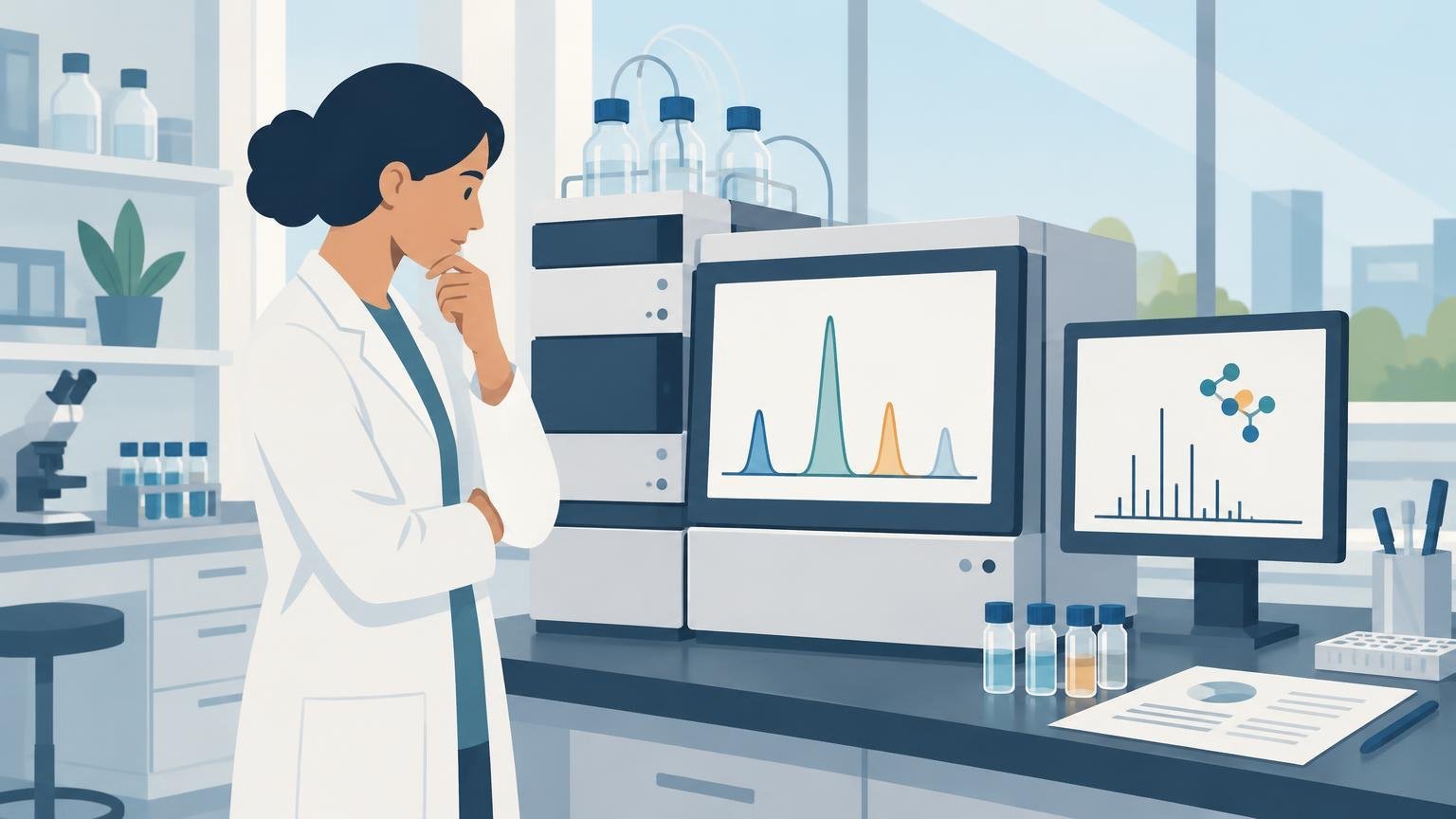
High-performance liquid chromatography separates sample components according to how they interact with a stationary phase in the column and the mobile phase moving through it. Reversed-phase HPLC is widely used for synthetic peptides because it can separate a target peptide from many structurally related substances.
A typical analytical sequence involves several stages:
- A defined amount of sample is prepared in a suitable solvent or diluent.
- The sample is injected onto the chromatographic column.
- A specified mobile-phase program carries the sample through the column.
- The target peptide and detectable impurities elute at different retention times when the method provides sufficient separation.
- A detector records the resulting signals as chromatographic peaks.
- The software integrates the selected peaks, and the main peak is expressed relative to the relevant total integrated area.
In simplified form, area-percent purity is calculated as the integrated area of the main peak divided by the total area of all peaks included under the method, multiplied by 100. The exact result depends on the procedure: the column, mobile phase, gradient, temperature, detector settings, integration rules, reporting threshold, and treatment of excluded peaks all affect what is observed and counted.
A chromatogram therefore needs context. A single large peak is reassuring only to the extent that the method can resolve the relevant impurities and the integration has been applied appropriately. Reading a peptide HPLC chromatogram requires attention to retention time, peak resolution, baseline behavior, integration boundaries, and the method used—not just the printed percentage.
Which peptide impurities can chromatography detect?
Synthetic peptide production can generate closely related molecular species. Depending on the sequence, synthesis route, handling, and analytical method, relevant impurities may include:
- deletion or truncated sequences;
- insertion sequences;
- epimers or other diastereomers;
- incompletely deprotected products;
- oxidation products;
- hydrolysis or deamidation products;
- disulfide-related variants;
- dimers, oligomers, or aggregates.
HPLC may separate some of these species from the intended peptide, allowing them to appear as secondary peaks. It does not follow that every impurity will be resolved. Structurally similar compounds can elute together, producing co-elution under a particular set of conditions. An unresolved impurity can contribute signal to the main peak and escape separate area reporting.
This is why chromatographic purity is a result from a method, not an intrinsic number that exists independently of measurement. A method that separates one impurity profile well may perform less effectively for another peptide or degradation pathway.
Why method suitability matters
A purity method must be fit for its intended purpose. The ICH Q2(R2) analytical validation guideline identifies characteristics such as specificity or selectivity, accuracy, precision, reportable range, detection or quantitation capability where applicable, and robustness. The exact validation strategy depends on what the procedure is intended to measure.
For peptide impurity testing, specificity is central. The method should distinguish the target peptide from the components likely to interfere with its measurement. Evidence can include representative chromatograms, resolution of closely eluting substances, spiking studies when suitable impurity materials are available, or comparison with an independent analytical procedure.
Robustness asks a related practical question: does the conclusion remain dependable when small, deliberate procedural variations occur? Precision asks whether repeated measurements produce sufficiently consistent results. These characteristics provide a stronger basis for interpreting the reported percentage than the percentage alone.
Does mass spectrometry test peptide purity?
Mass spectrometry primarily provides molecular-mass information. If the observed mass agrees with the expected mass, that finding supports the conclusion that the detected material is consistent with the proposed peptide. It answers an identity-related question that an HPLC peak area cannot answer on its own.
LC-MS combines liquid-chromatographic separation with mass detection. It can associate chromatographic peaks with mass information and may help characterize impurities that are not obvious from a conventional chromatogram. FDA-authored work has described high-resolution LC-MS applications for sequence confirmation, amino-acid-composition information, and impurity quantification in some co-elution scenarios. FDA staff research on peptide analysis
Mass agreement still is not complete sequence proof. Different molecular structures can present analytical ambiguities, and a matching mass does not establish stereochemistry, chromatographic purity, peptide content, or biological function. The European Medicines Agency’s guideline on synthetic peptides recommends at least two orthogonal identification methods for release testing in its regulatory context. Possible approaches include mass, retention time, LC-MS, peptide mapping, amino-acid analysis, bioactivity, and nuclear magnetic resonance, selected according to the peptide and the analytical question.
The important distinction is that HPLC separation and mass spectrometry are complementary. Chromatography asks how the detectable components separate under defined conditions. Mass spectrometry asks whether an observed mass is consistent with the expected analyte. Neither result should be relabeled as the other.
Purity, identity, and content answer different questions
| Analytical question | Typical method | What the result supports | What it does not establish by itself |
|---|---|---|---|
| How much of the included chromatographic signal belongs to the main peak? | Analytical HPLC or UPLC | Area-percent chromatographic purity under the stated method | Identity, absolute peptide content, sterility, or potency |
| Is the observed molecular mass consistent with the expected peptide? | Mass spectrometry or LC-MS | Mass-based identity evidence | Complete sequence proof, purity, content, or activity |
| How much target peptide is present relative to the sample or reference? | Calibrated LC assay, amino-acid analysis, quantitative NMR, or another suitable quantitative method | Peptide amount or content according to the method | Chromatographic impurity profile or sterility |
| Are higher-molecular-weight species present? | Size-exclusion chromatography where suitable | Information about dimers, oligomers, or aggregates detectable by the method | A complete account of all low-molecular-weight impurities |
| Does the sample meet a separate microbiological requirement? | A specifically designed sterility, bioburden, or endotoxin procedure | The attribute named by that procedure | Molecular identity or chromatographic purity |
Amino-acid analysis can contribute composition and quantity information, although hydrolysis and residue-specific behavior can affect some amino acids and modifications. Its interpretation must therefore reflect the actual procedure and peptide. A review of peptide amino-acid analysis discusses these methodological considerations.
The broader lesson is that no single test supplies every answer. A well-designed peptide batch-testing workflow assigns each quality question to an appropriate method rather than treating one HPLC number as a substitute for identity, content, microbiological testing, or biological activity.
When complementary tests are needed
Additional procedures should follow the peptide’s structure, known degradation pathways, manufacturing risks, and intended analytical claim. A chiral method may be needed when D/L amino-acid impurities or epimerization matter. Size-exclusion chromatography may be useful for higher-molecular-weight species. Separate methods are needed for attributes such as water, counterion content, residual solvents, elemental impurities, and process-related residues.
Orthogonal methods are especially valuable when one technique has a predictable blind spot. If a relevant impurity co-elutes with the main peak in one chromatographic procedure, a different separation or detection principle may reveal information that the first method cannot. Orthogonality is useful because the second measurement does not simply repeat the same assumptions.
How to evaluate a peptide purity report
A purity percentage is most informative when it can be connected to a specific material and method. A useful lot-specific analytical record should allow the reader to identify:
- the peptide or sequence analyzed;
- the lot or batch number;
- the analysis date;
- the chromatogram;
- the reported purity result;
- the analytical method or sufficient method conditions;
- the observed and expected molecular-mass result when identity testing is reported;
- whether the percentage is chromatographic area purity or a calibrated assay/content result.
Also check which tests are absent. A certificate that reports HPLC and mass spectrometry does not implicitly include peptide-content analysis, sterility testing, endotoxin testing, residual-solvent analysis, or a biological assay. A missing result should not be presumed to have been measured.
Regulatory guidelines can provide a rigorous framework for understanding analytical expectations, but their scope matters. The EMA synthetic-peptide guideline concerns medicinal-product active-substance development and manufacture. Citing its analytical concepts does not establish that a research-use peptide was produced or evaluated under that regulatory framework.
The strongest interpretation of a purity result
A peptide purity result is strongest when the claim remains matched to the measurement. “99% area purity by a specified HPLC method” is scientifically meaningful. “99% pure, therefore correctly identified, sterile, potent, and suitable for use” combines several unsupported conclusions.
From a biochemical perspective, the right approach is to separate the questions. Use chromatography to evaluate the impurity profile it can resolve. Use mass spectrometry and other orthogonal methods to support identity. Use a quantitative assay when peptide content matters. Use targeted procedures for water, counterions, solvents, aggregates, microbiological attributes, or biological activity. That framework makes the analytical record more informative than any isolated percentage.
Frequently asked questions
Is 99% HPLC purity the same as 99% peptide content?
No. HPLC area purity usually describes the main peak as a percentage of the relevant integrated chromatographic signal. Peptide content describes how much target peptide is present relative to the total sample or a defined reference basis. Water, counterions, and other materials can contribute to sample mass without appearing as peptide-related HPLC peaks.
Can HPLC confirm that a peptide has the correct identity?
Retention behavior can contribute to an identification strategy, particularly when compared with an appropriate reference, but an HPLC purity chromatogram alone does not unambiguously establish molecular identity. Mass spectrometry and other orthogonal identification methods provide additional evidence.
Can a peptide look pure by HPLC and still contain impurities?
Yes. An impurity may co-elute with the main peak, fall outside the method’s detection or reporting capability, or require a different test. The conclusion should be limited to impurities detectable and separable under the stated method conditions.
Does high peptide purity prove biological potency?
No. Chromatographic purity and biological potency are different attributes. Potency requires a suitable functional assay with its own controls and performance characteristics. A clean chromatographic profile does not establish receptor activation, cellular response, or a clinical outcome.
Does HPLC purity establish sterility or endotoxin status?
No. Sterility and bacterial endotoxin are separate microbiological attributes measured by dedicated procedures. An HPLC purity result cannot substitute for either test.