
TLDR
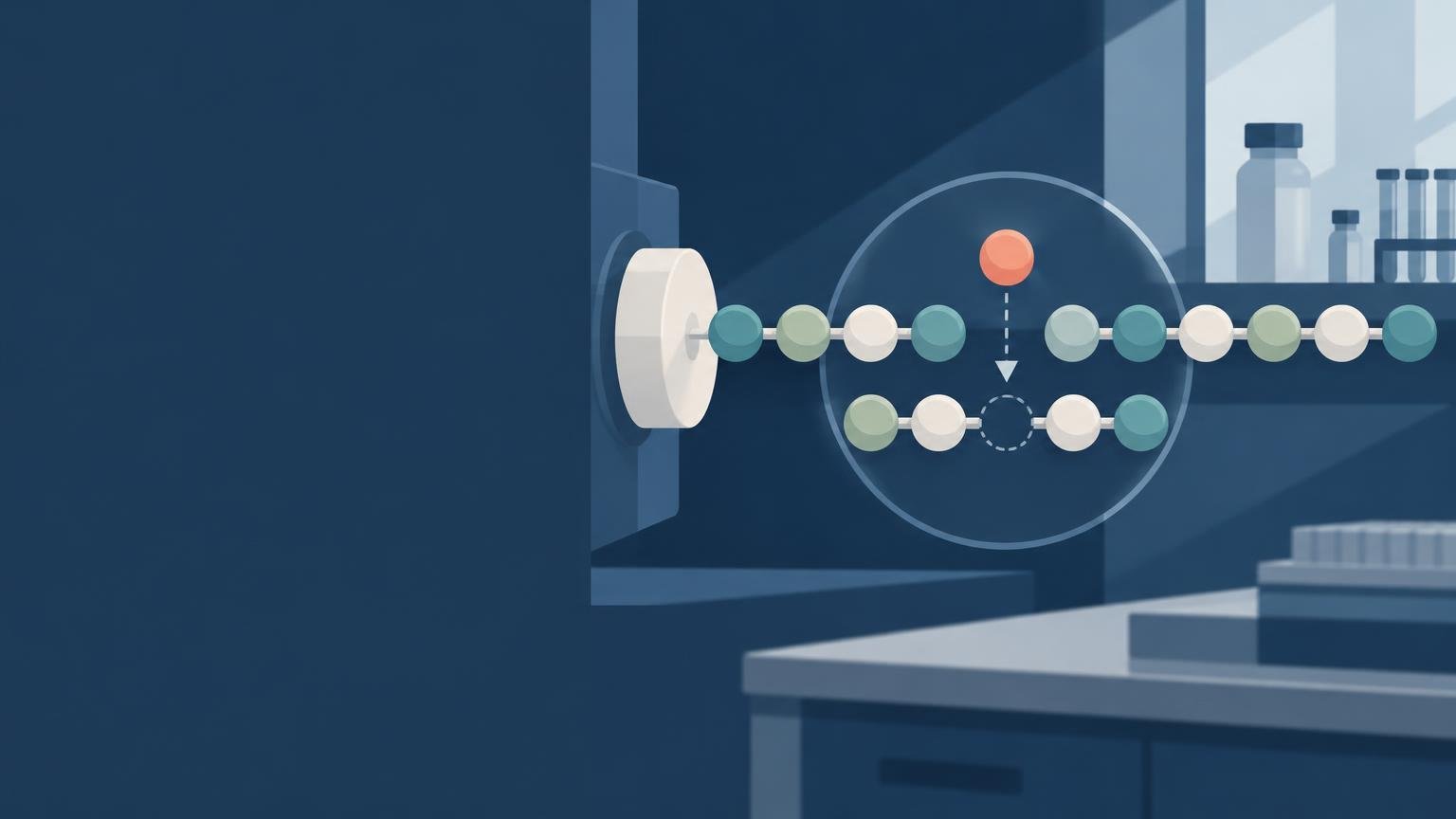
A deletion impurity forms when a growing peptide chain lacks one or more residues expected in the target sequence. In solid-phase peptide synthesis, an incomplete coupling can leave some chains unreacted. If those chains participate in later cycles, they can become near-full-length products missing the residue from the failed step. Repeated cycles amplify even modest inefficiencies, while steric hindrance, poor resin-bound peptide solvation, aggregation and incomplete deprotection can make particular sequence positions disproportionately difficult. HPLC and mass spectrometry can help characterize the resulting impurity profile, but neither nominal coupling efficiency nor an expected intact mass is equivalent to comprehensive purity or identity evidence.
How a missed coupling becomes a deletion sequence
Solid-phase peptide synthesis, or SPPS, builds a peptide through repeated deprotection, coupling and washing cycles. During coupling, the activated amino acid is intended to acylate every available terminal amine on the resin-bound peptide population. A deletion sequence is a related impurity in which at least one expected residue is absent. Process-modeling research on SPPS describes how incomplete reactions propagate through this cycle-based process.
Suppose a coupling reaches 99% conversion. Most chains accept the residue, but approximately 1% retain an unreacted terminal amine. If those failed chains are still chemically available during a later cycle, they may accept the next scheduled amino acid and continue elongating. The result is not necessarily a short, easily recognized truncation. It can be a near-full-length analogue that differs from the target by only one missing residue.
Capping changes that outcome by blocking unreacted sites after a coupling cycle. It does not repair the failed reaction. Instead, it prevents affected chains from continuing to grow into near-full-length deletion products. This trades a potentially difficult deletion impurity for a terminated chain that may be easier to separate, depending on the sequence and process.
Why repeated cycles magnify small inefficiencies
Coupling efficiency is a per-step property, whereas final crude composition reflects the entire synthesis history. As a simplified illustration, 99% success across 50 independent steps would leave about 60.5% of chains successful at every step: 0.99 raised to the 50th power. At 99.5% per step, the corresponding value is about 77.8%. These calculations are not predictions of isolated yield because real syntheses include deprotection failures, side reactions, cleavage losses, purification recovery and non-independent sequence effects. They show why a small per-cycle loss can become important in a long synthesis.
The location of a difficult step also matters. A failure early in the assembly leaves many subsequent cycles in which the affected chain can continue growing. A late failure produces a shorter synthetic history after the missed residue, but the resulting impurity may still closely resemble the target. This cumulative behavior helps explain why long peptide synthesis becomes progressively more sensitive to reaction losses rather than merely requiring more time.
Coupling efficiency depends on sequence context
No amino acid has one universal coupling efficiency independent of its surroundings. A monitored Boc-SPPS study found that efficiency varied with both the activated residue and the N-terminal residue of the growing resin-bound chain. Efficiency also declined with increasing peptide length under the conditions studied. The authors concluded that individual couplings should not simply be presumed complete and recommended monitoring and recoupling when necessary. Their difficult residue combinations remain protocol-specific rather than a universal ranking. The original coupling-efficiency study provides the experimental context.
Mechanistically, the terminal amine must be deprotected, accessible and adequately solvated for coupling to proceed. A growing resin-bound peptide can adopt hydrogen-bonded, beta-sheet-like organization or aggregate within the resin environment. Reagent diffusion and access to the terminal amine may then deteriorate. Steric congestion near the reaction site can add another barrier. These effects depend on the local and extended sequence, resin, solvent, loading and reaction conditions, which is why difficult peptide sequences require sequence-specific analysis rather than a fixed list of troublesome residues.
Not every deletion begins with incomplete coupling
Incomplete deprotection can create a similar final sequence error. If an Fmoc group remains on part of the resin-bound population, the protected chain cannot accept the residue scheduled for that cycle. If deprotection succeeds later, elongation can resume with the intervening residue absent. The analytical result may therefore look like a coupling failure even though the initiating event occurred during deprotection.
Some mechanisms can remove more than one residue. A mechanistic study of tirzepatide synthesis examined diketopiperazine-associated double-amino-acid deletions arising mainly during Fmoc deprotection and aging of particular proline-containing resin-bound intermediates. This is a sequence- and process-specific mechanism, not evidence that every proline-containing sequence will behave similarly. The published mechanistic study illustrates why an observed deletion should be investigated rather than assigned automatically to low coupling conversion.
Washing and reagent carryover matter as well. In a continuous-flow SPPS study, residual deprotection base consumed activated amino-acid species and contributed to insertion and deletion products. Nominal coupling time and reagent equivalents therefore describe only part of cycle performance; the chemical state entering the coupling step also matters.
How difficult couplings are managed
A defensible process treats coupling performance as something to measure and optimize. Depending on the sequence and platform, useful strategies can include monitoring residual amines, recoupling selected positions, adjusting activation conditions, improving resin swelling and solvation, modifying temperature or mixing, controlling wash efficiency, and capping unresolved sites. Position-dependent double coupling has also been used at sites anticipated to be hindered, although repeating a reaction does not guarantee completion.
These interventions should respond to evidence from the actual sequence and process. Aggressive conditions can introduce different problems, while a remedy that helps one difficult segment may offer little benefit elsewhere. The useful question is not simply whether a protocol uses double coupling, but whether the process controls the specific failure mechanism and produces an acceptable impurity profile.
Detecting deletion impurities requires complementary methods
Crude SPPS material can contain deletion and insertion peptides, epimers, oxidation products, protecting-group-related species and cleavage or deprotection by-products. Detecting the expected intact mass confirms that a mass-consistent target species is present; it does not characterize every related impurity in the preparation.
Reversed-phase HPLC can separate and estimate chromatographic components, and it is widely used in peptide purification. A one-residue deletion may nevertheless have retention behavior close to that of the target, making resolution difficult. LC-MS adds mass information to chromatographic separation, while high-resolution methods can improve investigation of closely related or co-eluting species. A review of LC-MS characterization for synthetic peptides discusses both the value and the interpretive pitfalls of this approach.
The important distinction is that coupling efficiency, crude purity, purified chromatographic purity, molecular identity and peptide content answer different questions. A high conversion estimate for one step does not establish final purity. A strong HPLC area percentage does not by itself prove the identity of the principal peak. An expected mass does not establish peptide content or exclude every co-eluting impurity. A useful analytical package connects the method and result to the property being claimed, as explained further in this guide to HPLC, LC-MS and peptide purity measurements.
The practical conclusion
Deletion impurities are historical records of imperfect synthesis cycles. Incomplete coupling is a major route, but deprotection failure, sequence-dependent aggregation, carryover and specific side reactions can produce similar or more complex outcomes. The most effective response is to identify difficult positions, monitor the relevant chemistry, prevent failed chains from propagating when appropriate, and use complementary analytical methods to determine what the final material actually contains.
Frequently asked questions
Is a deletion peptide the same as a truncated peptide?
Not necessarily. A truncated peptide stops growing before the target length is reached. A deletion peptide can resume elongation after a missed residue and approach or reach the target chain length while lacking one or more internal residues.
Does double coupling eliminate deletion impurities?
Double coupling can improve conversion at a difficult position, but it does not guarantee a complete reaction or correct failures caused by incomplete deprotection, poor washing or other mechanisms. Its value should be established for the specific sequence and process.
Can mass spectrometry alone prove that a peptide has no deletion impurities?
No. Mass spectrometry can provide strong molecular-mass evidence, especially when combined with chromatographic separation, but detectability depends on ionization, abundance, resolution and co-elution. Orthogonal chromatographic and mass-based evidence provides a more informative impurity assessment than an expected intact mass alone.
References
- Simulation-Based Optimization of the Solid-Phase Peptide
Synthesis Process - Coupling efficiencies of amino acids in the solid phase synthesis of peptides
- 10494
*J. Am. Chem. Soc.* 1997, 119, 10494–10500
- Incomplete Fmoc deprotection in solid-phase synthesis of peptides
- Mechanistic Study of Diketopiperazine Formation during Solid-Phase Peptide Synthesis of Tirzepatide.
- Total wash elimination for solid phase peptide synthesis
- Controlled aqueous nanoassembly-driven fully automated Fmoc solid-phase peptide synthesis (SPPS) with in-water coupling
- Related impurities in peptide medicines
- Purification of Peptides from Solid-Phase Peptide Synthesis with RP-HPLC.
- Characterization of Synthetic Peptide Therapeutics Using Liquid Chromatography-Mass Spectrometry: Challenges, Solutions, Pitfalls, and Future Perspectives